
logo open temple

Open Temple

Inspired Hearts

Inspired Hearts
By Rabbi Lori Shapiro

Dancing. It moves the body, uplifts the fallen neshama and clears the mind. Like the Sufi spinning in accord with the constellations, Israeli dance captures a small piece of the universe within a small space for a unique period of time. If Shabbat is a Temple in Time, as Abraham Joshua Heschel famously stated, then Dance is the Discipline of the Priests.

It is clear that we are called upon to be Dancers. In Hebrew, there are no fewer than 11 words for dance – Leap! (Dalag), Whirl! (Karar) and the catch all Dance! (Raqad). We should also Alats, Giyl, Pacach, Pazaz, Chagag, Mechowlah, Machowl, and Chiyl – Twist, Whirl, Circle Dance, Dance in Company, March in Procession, Jump, Leap, Skip, Spring, Hop, Skip, Spin under the influence of joy and triumph. Yes, we should dance…we should dance our tuchuses off.

And yet, for many of us, our sedentary society has created an exilic experience with dance. When presented with a dance floor, we feel dis-ease, resistance, malaise. It is as if the barrier of entry for such a flat plain were as high as Mt. Meron.

Well, it’s time to change all of that.

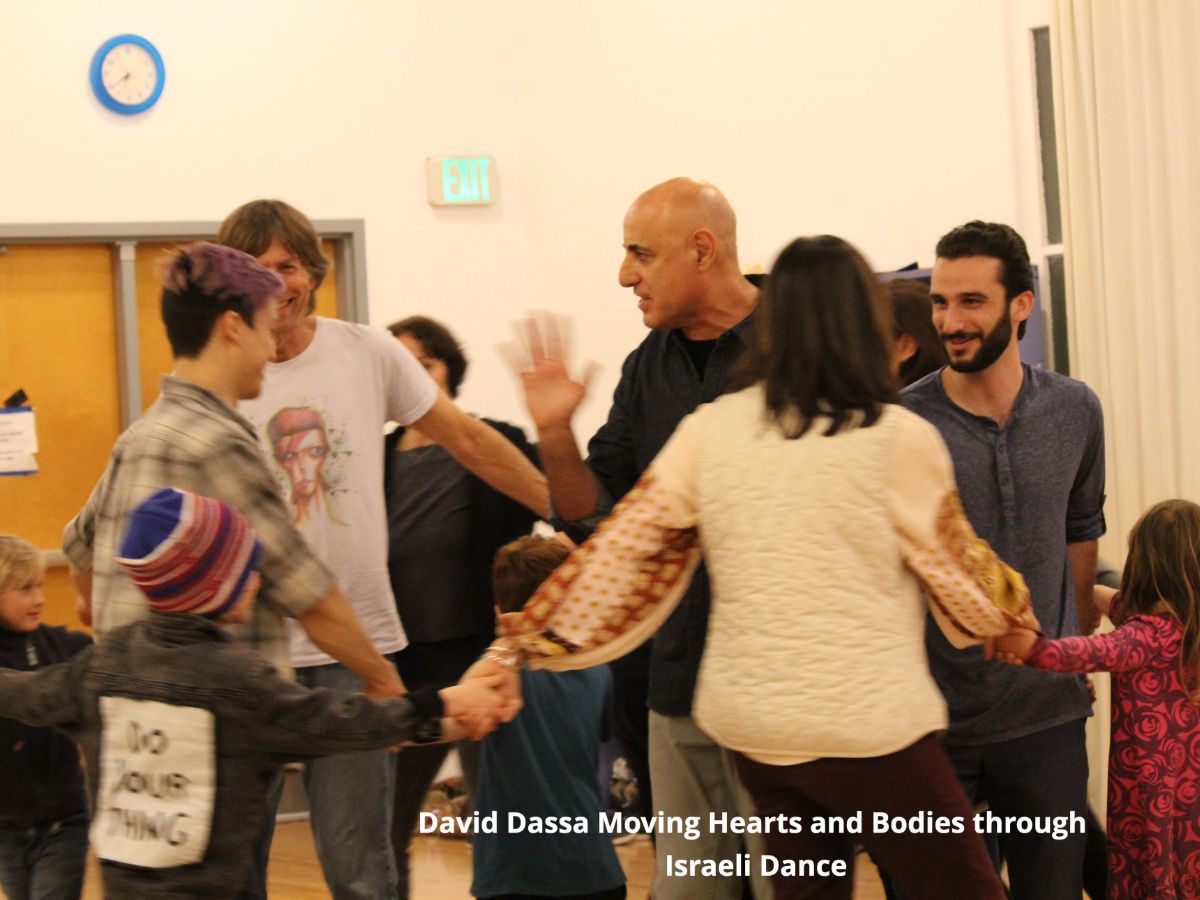
Open Temple is excited to partner with Israeli Dance Choreographer and Instructor David Dassa. David is a living treasure, and the son of living legend Danny Dassa. As David explained to me one recent morning at Zinque, “there are about five dancers around the world who make their living teaching Israeli dance, and I am lucky to be one of them.” David converts the uninitiated into an Israeli dancing machine, leaving community and joy in his wake. Just look at the photo, above.  Everyone dancing is smiling.

Open Temple’s core values are Creativity, Love and Truth. We believe that creativity engages all of us in something greater than ourselves. This week’s Torah portion is clear – every one of us has an offering of the heart that only we can give – and in exchange, we will experience Transcendence. The creation of a spiritual community is a covenantal relationship that promises to bring us to life. And at Open Temple, we do that – through the Art of Judaism, Music, Dance, Performance Art and the Word. Verse 25:8 in Parshat Terumah invites us to: “Asu li Mikdash v’shanti b’tocham” – Build for me a Holy Space so I may Dwell Amongst You.”

Open Temple continues to build this Holy Space as an open temple – in our hearts, in our homes, in our community. And through this opening, the Force of Life enters into us, animating us with the life force – what the Torah describes as Godliness – of what it means to be alive.  This same force opens our hearts towards acts of loving kindness, it activates the mind towards positive thought, it is the force of human potential for us to enact upon. And all that it takes is that first step.

Come, Dance with Us.

with love and Torah light,
Rabbi Lori

Inspired Hearts Read More »

On the Road…

Traveling in the Negev on Road 40.

On the Road…
By Rabbi Lori Shapiro

T’filat HaDerekh, or “Wayfarer’s Prayer” is the prayer we say upon setting off on a journey. It is a prayer of comfort that acknowledges “Hey, G?d, I’m going on this journey and I want you to know about it…the rest is up to me.”  We ask for protection as we are about to leave the city limits and beyond.  It is said once a day, to be repeated after sunset if the journey begins at that time.

This week’s Torah portion, Mishpatim, is one of the source texts for this prayer. In Exodus 23:20 God states:

הִנֵּ֨ה אָנֹכִ֜י שֹׁלֵ֤חַ מַלְאָךְ֙ לְפָנֶ֔יךָ לִשְׁמָרְךָ֖ בַּדָּ֑רֶךְ וְלַהֲבִ֣יאֲךָ֔ אֶל־הַמָּק֖וֹם אֲשֶׁ֥ר הֲכִנֹֽתִי׃

“I am sending an angel before you to guard you on the way and to bring you to the place that I have made ready.”

[pull record needle off of record and make skid sound]

“Uh – Angel?”

I recall a practical rabbinics class one winter day in 2005 when a colleague of mine presented a case of a congregant who only wanted to talk about angels. Our rabbinic supervisor responded, “well, you know that you can’t permit her at the synagogue if she is going to talk about angels. You need to tell her that she can not talk about angels and that if she continues to lead the conversation in that direction that she is not invited back.”

It was winter, but that was not why I felt chilled. I could not believe what I was hearing. If the Torah so clearly mentions Malach” – which is translated as a messenger, or angel – why couldn’t congregants discuss this concept, which has its roots in the Torah?  Or, even more radical – why can’t someone believe in a angels if they choose to?

“We are NOT the people of the book; we are the people of the interpretation of the book.”

These words echo in my mind. Ours is an interpretive journey. Torah is a state of mind, of interpretation, of intellectual and spiritual curiosity. Concepts such as angels, a pavement of sapphire in the sky, knowing through doing…” all of these ideas find their way into this week’s Torah portion.  Known as a list of “case laws,” Parshat Mishpatim is the hidden truth of Torah – read it literally, and it is a collection of dos and don’ts. Read it with interpretive power, and it sets the mind and body ablaze.

Look for angels in our lives…sensitize ourselves to fully inhale a sunset…break our hearts open each time we see a man or woman with a sign at a stop light.  The laws of Torah are to arouse our humanity and dignity; not stymie them.

Torah is to be interpreted, challenged, embodied and lived through our hearts, our hands and our ability to experience empathy.  And like the sapphire path above the Israelite’s heads at the closing of the Torah portion, the sky is the limit.

Fly, Angels.

On the Road… Read More »

Circles

Circles
By Rabbi Lori Shapiro

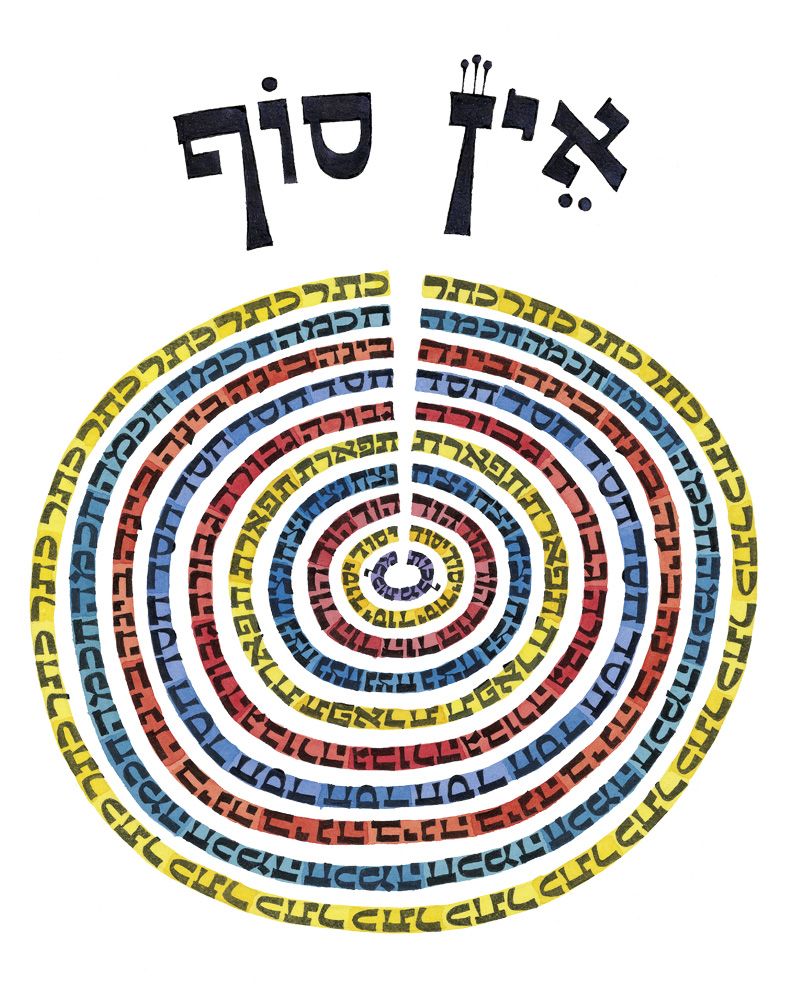
Ein Sof. Without End. All My Life’s a Circle.

Circles are 360 degrees – Double Chai for a minyan. And its circumference, while measurable, is also an endless roundabout caught in π. Circles are an endless fascination, and Torah, maintaining its analog appeal, “turns and turns,” like a wheel, “with everything inside.”

Literary Biblical scholar Avivah Zornberg in an interview with Krista Tippet reminds us of “one of the extraordinary, recursive references in the [Exodus] story. Over and over again, God says to Moses, Moses says to the people, ‘All this is happening so that you shall tell the story.’

It’s the Biblical Storytelling Circle Game.

“It’s so upside-down, you might say…” continues Zornberg, “Since it’s happened, all right, tell the story. Make sure people remember it. But that’s not the point. It’s not telling the story so as to remember what happened. It happened so as to be the stimulus for a meaningful story. And the stories will develop and change through time. And perhaps, in the end or along the way, you might find yourself telling a better story than what is actually written in the text. So long as there is some connection. So that what you have, for instance, on the Seder night, on Passover, is basically the commandment to tell the story of the Exodus, which doesn’t mean reading the Bible. It means — you know, it isn’t just opening up the Bible and reading.”

It’s at this point Rabbi Lori chimes in to the conversation between Krista Tippet and Avivah Zornberg (as if!): It’s about letting the story run through each of us. It’s about turning the story until all that is inside becomes revealed and refracted through our unique Neshamot (souls) finding their voice in the choir of voices that came before us and live through us today. It means being a part of our circular storytelling tradition…with one another.

Enter Open Temple Circles.

In the week of Parshat Yitro, Open Temple reveals emerging Circles of Practice within our community: Shabbat/Creativity Circle, Healing Arts Circle, What’s Next Circle (for Boomers) and a Poetry Circle. You are invited to explore the circles of practice and interest (below). Together, we will write the Torah running through us through healing, writing, exploring life’s meaning and rituals together as we Open our Temple.

With blessings of Light and Revelation,
Lori

Healing Arts Circle:

Tuesday, January 29th 7:30 pm

Boomer “What’s Next” Circle:
Tuesday, February 5th 6:00 pm

Poetry Arts Circle:
Wednesday, February 20th 7:00 pm

Shabbat/Creativity Circle:
Tuesday, February 26th 6:00pm

More info: info@opentemple.org

Circles Read More »

The Great Exodus March

The Great Exodus March
By Rabbi Lori Shapiro

There’s a rabbinic midrash on Exodus 14:13, an interpretive story inspired by the Torah, that goes something like this: As the Israelites stood with the blanket of the Red Sea before them and Pharaoh’s army behind them, there were four different reactions:  the first was to say “Let us throw ourselves into the sea.” The second said, “Let us return to Egypt.” A third declared “Let us wage war upon the Egyptians,” and then a fourth chorus cried, “Let us pray to God.” The rabbis teach that Moses’ response rejected all four opinions, and implored the people, “Fear not; stand by, and see the salvation of God which God will show to you today.”

One might read Moses’ response as satisfactory; or, less so – as a passive call to God’s miracles. As one who doesn’t necessarily know what God is or even that God is, and even considers the entire construct of a sentence that begins with “God is…” an impossible consideration, the concept of miracles enacted upon us by a personal God alienate my spirit of what is possible.

And so, what might Moses have meant?

It is here that I call upon what is more relatable — this weekend.  As we “Turn our thoughts today to Martin Luther King…,” (to quote James Taylor), might we reveal the hidden message of Moses’ instruction through the prism of Hebrew? In a playful shuffling of the Hebrew, without bounds or ties to vowels, a verse traditionally invoking a (possibly) unknowable G?d, converts from the passive instruction: “Fear not; stand by, and see the salvation of God which God will show to you today,” into a Call to Action:  God! Radical Amazement! Rise up and See God’s Transcendent Presence that One (You) Will Make Happen Today.”

It’s the moon that moves the tides; the currents, tectonics and weather that makes waves; it is the energy of one body interacting with another that Causes for Creation. It is not in heaven – it is of us, upon us, within us all.

The Presence is Here. The Time is Now. And the One is You.

Freedom Shabbat.
Find your Wave.
Make it Happen.
This Friday at 7:15.

With Love and Torah Light,
Lori

The Great Exodus March Read More »

The Miracle of Waves

The Miracle of Waves
By Rabbi Lori Shapiro

Ocean waves. Radio waves. Birthing waves. Waves reveal the presence of something greater than ourselves in action. Ocean waves are water’s way of revealing its interplay with the wind and its underworld. Radio waves are imperceivable until they are harnessed by a transmitter or antenna to reveal their hidden messages. The waves of childbirth move through the mother, unleashing a chemical reaction that spasms the body into the birth of life in an experience that I called “a visitation from Shechinah“. We are all transformed and born through The Waves that, unknowingly yet ceaselessly, surround us.

Our Torah cycle reads like the greatest of Hollywood films these weeks, with Freedom Fighters and Pharaohs. I invite you to experience the miracle of the parting of a sea with towering waves juxtapositioned with images of the biggest wave surfed ever recorded (see video, above) as a visual meditation with the kavanah (intention) of recalling that we live in a time of miracles that we can strive to perceive and experience. From receiving this message in the palm of your hand, to finding love and friendship, to our health, to our beautiful Venice seaside, the parting of the Red Sea reminds us to Find Our Freedom through the Small Miracles that happen in our lives every day.

Each of us are a product of the waves. Each of us are drawn to them. Each of us has a purpose that creates a wave.

Find Your Wave.

with Love and Torah Light,
Lori

The Miracle of Waves Read More »

Last Night of Hanukkah

Open Temple’s “Hanukkah on the Canals Parade” Party
Source: The Jewish Journal

Armando at the Jewish Journal visited our Eighth Night Hanukkah on the Canal Parade Party with Open Temple and turned out this amazing video capturing the experience. May the lights continue to shine! Thank you, Armando!

Last Night of Hanukkah Read More »

Shammai Hanukkiah

A Shammai Hanukkiah.
By Rabbi Lori Shapiro

The story of Hanukkah is a literary tel, formed over several millennia, its origins spinning through the Book of Maccabees I and II though Josephus, the Talmud, Maimonides and beyond; it’s a literal literary time machine.  And if each evolving civilization imprints its own addition to this tale, might we look around at our times and ask “what is our contemporary contribution to the telling?” Perhaps, this year, no matter is more important to illuminate than the Spirit of Machloket (disagreement).  Most famously preserved in the mental sparring of rabbis Hillel vs. Shammai, the rabbis of the Talmud respectfully preserved the minority opinion in matters of dissent.

When lighting the Hanukkah Menorah, aka the Hanukkiah, according to the House of Hillel, we begin with one light and increase the light each day until we have all eight illuminated. What if, this year, all of us reclaim the Shammai Hanukkiah; Hillel’s sparring partner and primary adversary. Perhaps this year, in addition to our beloved Hillel Hanukkiah (Shabbat Bavli, 21b), we follow Shammai’s teaching and begin with a blaze of all eight candles, symbolic of the great fires in our city, state and nation, and practice a Shammai reduction of the flame for eights nights as a meditation of our human condition – humbled in the face of nature’s power, our hunger for unity and the work it takes to become one?

This Hanukkah, Open Temple shares this tradition at our annual “Hanukkah on the Canal Parade” as we gather and dedicate ourselves to the search for light in times of darkness.  We hearken to the sounds of strangers and invite the Other into our hearts and homes as an eight night meditation of reduced light to guide our return; until a singular candle, representing all of us, together and alone, becomes our sole companion; a singular light, reminiscent of the mystery and promise of creation; all of us – One.


Shammai Hanukkiah Read More »

On Religion

On Religion
By: Rabbi Lori Shapiro

Spiritual but not Religious is the Cis-Gender identity of the millennial seeker.  It’s a way of saying “I like yoga class, I honor my body with organic kale chips lightly grazed by a free range buffalo on the wide open plains of a lesbian run eco-village in Southern Utah, and my parents divorced when I was 11, so they left religion for me to figure out so I am vegan except for Carrot Cake on special occasions.”  

It’s complicated.  But not really.

If there was a way to crawl into the minds of those who lived 100, 200, 500, 2000 years ago, would you?  If there was a time machine of the mind where you could, with immediacy, understand the way of the world before there were sound bites, tweet updates, insta-rags and pinterest-ing distractions, would you go for the ride?  

To begin with, I find most things really onerous these days.  When given the chance to do much, I opt to do less.  Less tweeting, less insta-gratifying, less social media binging.  It’s enough to get my own life straight, let alone judge another’s.

And yet, it’s like like proverbial car-wreck that we can’t turn away from.  And we are the test-dummies strapped in for a head-on as we push full force into the accelerator.  It’s like we can’t live without these grandiose displays of human carnage through lurid tales of sexual assault, obituaries of shooting victims, photos of fires ranging through homes, and the tweets, pushes and messages that bombard us with them.

So, step on board and see that we are no different today than we were 100, 200, 500 or 2000 years ago. And maybe that’s why we are repeating these indiscretions with such alacritious force and disfunction. Maybe it is the very denial of our right to know those who came before us that creates in us the curse of repetition.  

In my own short life, I’ve lied, I laid, I’ve loved and lost and laughed at things that I shouldn’t have.  I’ve seen disfunction from my own family to those I dwell next door to, and as I open this book, this scroll, this daph, I know that it is all just a part of this human experience.

The matriarchs and patriarchs hadn’t figured any of this stuff out any more than we did.  They gossiped with cunning and shtupped wantonly from one partner to another. The only differences between them and us is that their lives were reframed in context of a higher ideal, and their promiscuity was in service of something larger than themselves.  

We’re in the thick of Genesis this week, and we’re also in the thick of family relationships.  If the Torah is a “Book of Laws” why didn’t it begin with “This is the first law?”  Rashi, the famed 11th c. commentator asks.  “To Learn Derekh Eretz” is his ostensible answer.  And what is Derekh Eretz?  Literally, it means “the way of the earth.”  But, metaphorically, it is the way of the earth – our passions, love, and desire to elevate our lives into meaningful and beneficial experiences.  Abraham? Iconoclast and Rebel who renewed Monotheism in the ancient world.  Rebecca?  Cunning and Measured which she converted into Genrousity.  Leah? Perhaps a great lover who flourished in Motherhood.  Moses? A reluctant player in the God narrative with a speech impediment who rose to the call of Leadership.  

So, what will it be for us as we face our families this Thanksgiving?  Will we succumb to the same pitfalls of conflict, or will we elevate the conversation to reflect our greatest selves?  If we could reframe our fatal flaws in service of a larger ideal, what meaning would it bring to our lives?  

This is the fabric from which the tales of religion were woven.

Spiritual but not religious?  I have no idea what you mean.

On Religion Read More »